Saturday, April 2, 2011
Souvenirs
It's getting to be about that time where I start needing to think about possible souvenirs to bring home. Today, I went to a fair for local artisans, and a lot of the stuff was either unremarkable, overpriced, or both. I did manage to find a couple things that I liked though, including something called a kwi, which is half of a kalbas (like a large squash) that's hollowed out into a bowl. I also bought some postcards and found other stuff that looked interesting but that I might buy later, including some artwork with a bit of depth to it. Any other thoughts about possible souvenirs?

Friday, April 1, 2011
Games
When I went to a different branch of the library the other day, I found a book -- actually a photocopy of a book -- of traditional games of the Creole population. It is so much fun to read. Basically, at night, before I go to bed, I read about five or six entries and I summarize them for the dictionary project. Every so often, I come across a game that I think would be fun for the U.S. For example, there's a game called Paganni ké poul roughly 'fox and hen', in which one player is a fox, one player is a hen, and everyone else lines up behind the hen and are her chicks. The hen has to move laterally, arms (wings?) outstretched, protecting the chicks from getting tagged by the fox. There's another one called Jwebar, a bit like capture the flag with no flag, in which you have two teams, and each team has their own side to defend. Each player has the right to tag (right to tag = bar) one other person from the other side when they come to the opposing side to liberate their previously tagged friends. The game ends when one team is fully captured (or recess ends).
There's other games, however, like poté which have exact correspondents in the U.S. Our correspondent is to poté is 'tag'. There's another game that works almost exactly like jacks, which, as it happens, is a very popular game in Haiti. I forgot to bring the book with me to the internet cafe, but there's also an equivalent to 'Eeny meeny miney mo' (except without the ugly racist history behind it).
In any case, as soon as I saw this book, I knew it was a linguistic goldmine, and French Guiana has tons of goldmines, as I believe I mentioned in Post 100. In fact, it was the gold strikes of the 1800s that first brought over the Chinese, Indians, Indonesians, and Antilleans that form much of the diverse community today. French Guianese society is so thoroughly mixed that when you see a last name like Tien-Long (the leader of the Regional Council) or Mam-Lam-Fouck (the most prominent historian of French Guiana), you should not be surprised when someone who shows no trace of Asian roots shows up. Anyhow, it is really the influence of the Antilles that shows up in the games, as every so often, I'll read one of the chants that accompanies the game and I'll see a word or two that is clearly not from French Guiana, but rather was imported from the Antilles. I geek out and write it down when I see things like that, because it's that type of mixture that I'm looking for in my dissertation.
There's other games, however, like poté which have exact correspondents in the U.S. Our correspondent is to poté is 'tag'. There's another game that works almost exactly like jacks, which, as it happens, is a very popular game in Haiti. I forgot to bring the book with me to the internet cafe, but there's also an equivalent to 'Eeny meeny miney mo' (except without the ugly racist history behind it).
In any case, as soon as I saw this book, I knew it was a linguistic goldmine, and French Guiana has tons of goldmines, as I believe I mentioned in Post 100. In fact, it was the gold strikes of the 1800s that first brought over the Chinese, Indians, Indonesians, and Antilleans that form much of the diverse community today. French Guianese society is so thoroughly mixed that when you see a last name like Tien-Long (the leader of the Regional Council) or Mam-Lam-Fouck (the most prominent historian of French Guiana), you should not be surprised when someone who shows no trace of Asian roots shows up. Anyhow, it is really the influence of the Antilles that shows up in the games, as every so often, I'll read one of the chants that accompanies the game and I'll see a word or two that is clearly not from French Guiana, but rather was imported from the Antilles. I geek out and write it down when I see things like that, because it's that type of mixture that I'm looking for in my dissertation.
Thursday, March 31, 2011
Sweets
As many of you know, I have a big sweet tooth. Here in French Guiana, there is a lot to satisfy it. One thing that I'm quite grateful for is the presence of the French pastry industry. I can always get a good pain au chocolat at one of many local bakeries. I've had amazing cream puffs, and occasionally a piece of cake. On Saturday, I bought a Gateau basque. For those of you from the northeastern U.S., this tastes exactly like the cake version of a Stella D'Oro Breakfast Treat. If you've never had one of these cookies, I pity you, as they are AMAZING. But there's also a lot of local goodies. The last time I was here, I posted about having accras. Accras are the French word for what's known in Guianese Creole as marinad, or in English 'fritters'. At a local Haitian place, you can get 8 banana fritters (about the size of a doughnut hole) for only 2 euros. Today, I was at the market and I bought some sispa (literally 'six pieces'). This is a local specialty, about the size, shape and color of a rice-cake, but much denser. It's made principally of taro flour, flavored with sugar, cinnamon, vanilla and cocunut. Pretty good, but not great. There are also local jellies that are great. Chadeck (like a grapefruit but way bigger), mango, banana with honey or rum, pineapple, lime, and even tomato-vanilla (not a fan). Then there's the ice cream. I LOVE the flavors here. Peanut, soursop, guava, coconut, pineapple, and more. I have to be VERY careful to limit my intake of these to one liter every three weeks or else I'll need to buy a second ticket to get back. There's also a not-so-secret code about how to buy three particular fruits that aren't sold at the market. If you see a yellow flag, it means patawa is for sale. If you see a red flag, it means açai is for sale. If you see a white flag, it means komou is for sale. I haven't yet gone into any of these establishments to but the fruits but I plan to soon.
Wednesday, March 30, 2011
Making strides
The last couple of days have been pretty darn awesome, I have to say. Last night, after I got home early, I watched the show A Kouman ('Huh?') for the first time. This is a short, 8-minute show that spotlights the different languages spoken in French Guiana. Last night's language was Russian, spoken by people working for the Space Center.
Then, as I was marinating some fish, I had a nice discussion with Dominique (my landlady), Alex (her significant other) and Alyssa (his daughter) about my project and Haitians/immigration in French Guiana more generally. This is a very intellectually engaged family, and it's nice to be able to weigh in and show my knowledge too. Too often, I'm reduced to sitting by, observing, taking in the discussion, but not being able to participate. While I'm learning a LOT about French Guianese society, I'm really not in much of a position to contradict people or add new knowledge to the discussion. But last night, I felt like I was on an equal footing because of my knowledge of the Haitian community here and elsewhere.
After firing off a few text messages setting up my first training sessions for my interviewers, I went back to my fish. I made my first 'pimentade'. A pimentade is a fish stew made by marinating fish in lime juice, onions, garlic, salt & pepper for a few hours, then sauteing more onions and garlic with tomatoes in a pot. After a few minutes, you add about a cup of water with a teaspoon of roukou ('lipstick tree spice') dissolved into it. Once that comes to a boil, you add the fish and its marinade, and cook it till it's fully cooked. And then you enjoy it. It's really good. I'll be bringing plenty of roukou home with me.
Then today, I had my first training session. I'm really glad my advisers told me to do this, because it is not at all intuitive to do these interviews. Essentially, they have to be able to strike up a good rapport with people, make sure they're always talking, respect the time limits for each part of the interview, and never correct people even when they use words that aren't Haitian. All of this can be quite difficult, and this person didn't seem to be a natural, but that's ok, because she has what she needs to be able to work on it at home, to get more comfortable with it, to speak with people who are actually Haitian (rather than me playing a 40 year old Haitian man).
Once that was done, I went to the library, except I went to a different brach, where a friend of Dominique's works. The other branch was taking its sweet damn time getting back to me about whether I could have a library card. When I went today, they told me I'd already been approved, even though no one bothered to tell me. So I have to go back tomorrow with 31 euros, a proof of Dominque's address, and a passport-size photo (which I have left over from my international driver's license). I'll also be allowed to use the internet there, which means no more paying by the hour.
So all in all, a pretty good couple of days. More news soon.
Then, as I was marinating some fish, I had a nice discussion with Dominique (my landlady), Alex (her significant other) and Alyssa (his daughter) about my project and Haitians/immigration in French Guiana more generally. This is a very intellectually engaged family, and it's nice to be able to weigh in and show my knowledge too. Too often, I'm reduced to sitting by, observing, taking in the discussion, but not being able to participate. While I'm learning a LOT about French Guianese society, I'm really not in much of a position to contradict people or add new knowledge to the discussion. But last night, I felt like I was on an equal footing because of my knowledge of the Haitian community here and elsewhere.
After firing off a few text messages setting up my first training sessions for my interviewers, I went back to my fish. I made my first 'pimentade'. A pimentade is a fish stew made by marinating fish in lime juice, onions, garlic, salt & pepper for a few hours, then sauteing more onions and garlic with tomatoes in a pot. After a few minutes, you add about a cup of water with a teaspoon of roukou ('lipstick tree spice') dissolved into it. Once that comes to a boil, you add the fish and its marinade, and cook it till it's fully cooked. And then you enjoy it. It's really good. I'll be bringing plenty of roukou home with me.
Then today, I had my first training session. I'm really glad my advisers told me to do this, because it is not at all intuitive to do these interviews. Essentially, they have to be able to strike up a good rapport with people, make sure they're always talking, respect the time limits for each part of the interview, and never correct people even when they use words that aren't Haitian. All of this can be quite difficult, and this person didn't seem to be a natural, but that's ok, because she has what she needs to be able to work on it at home, to get more comfortable with it, to speak with people who are actually Haitian (rather than me playing a 40 year old Haitian man).
Once that was done, I went to the library, except I went to a different brach, where a friend of Dominique's works. The other branch was taking its sweet damn time getting back to me about whether I could have a library card. When I went today, they told me I'd already been approved, even though no one bothered to tell me. So I have to go back tomorrow with 31 euros, a proof of Dominque's address, and a passport-size photo (which I have left over from my international driver's license). I'll also be allowed to use the internet there, which means no more paying by the hour.
So all in all, a pretty good couple of days. More news soon.
Tuesday, March 29, 2011
Post 100
A big topic of discussion among those I talk to the most is the potential independence of French Guiana, and this post is a synthesis of the views of locals I’ve spoken to as well as my own views. As you might know if you’ve talked to me or read a bit about this place, French Guiana is a department of France, the largest one in fact. This means that it is as much a part of France as any of the departments of the mainland, or for those of you reading from the U.S., it is as much a part of France as Hawaii is a part of the U.S. At least in theory that’s true. In many important ways, French Guiana is not part of France. Take this small example from my life: When I studied abroad in Paris in 2005, I was told that my bank had an agreement with one of France’s largest banks, which is present here. If I used my American card at any of this bank's ATMs, I would not be charged any special fees. Fast-forward to last year’s trip to French Guiana: I used the French bank's ATMs exclusively, and when I got home, I found numerous charges on my statement for using the card overseas. When I went to my bank to find out why (after all, it had been 5 years; perhaps the agreement had been dissolved in the interim), I was told that it was because it didn’t honor that agreement in French Guiana; it was “only in France” that it was valid. When I explained to the manager that it WAS indeed part of France, she expressed sympathy but said that she couldn’t do anything because it was corporate policy not to recognize French Guiana as ‘France’. A friend of mine from the mainland said he called his cell-phone company, Orange-France, to complain about service here. He was told that here it’s Orange-Caraïbes, and that the France division was unconcerned. And of course, that’s just some of many ways French Guiana is marginalized. It is so marginalized that friends here tell me that their friends in the mainland don’t realize that French Guiana isn’t an island. One woman, whose home I visited when looking for a place to live, told me that even her friends in Martinique and Guadeloupe (other French Caribbean departments) don’t even want to visit her in Cayenne because they didn’t want to get attacked by pumas (which are not found here in the city, I promise). The specificity of the French Guianese situation is hardly recognized by France, which treats it in many ways just as it does all its other departments. So you have thousands of little black, Amerindian, and Asian schoolchildren reading the textbook Nos ancêtres les Gaulois (Our ancestors from Gaul). Of course, these children are not descended from the inhabitants of Gaul, nor are they even anywhere close to where Gaul was. It also sends all sorts of goods from the mainland to French Guiana. Yet in other ways, the French government recognizes that here, it is different. As with the other overseas departments and territories, France gives a pay increase (40% here) to those government employees willing to accept positions here. They also institute an ‘Overseas Tax’, meaning that not only are things more expensive due to the cost of shipping, but also there is an additional layer of price-inflation. So you might pay as much as 8 euros for brand-name cereal, or 84 euros to fill your tank with the highest gas prices of Europe. And of course, France has no intention of letting French Guiana start importing directly into the region, so coffee from the neighboring country of Brazil goes to mainland France first, only to return here, and the prices get doubled. Meanwhile, the government has gone on TV saying that French Guiana’s economy is great, due to the investments in the European Space Center, located in Kourou. As if to rub salt in the wounds of the residents, President Sarkozy has had his Minister of Overseas Departments and Territories propose a new, modern instantiation of the Jardin d’Acclimation. The Jardin d’Acclimatation was an expo from the 19th century where people from France’s (largely tropical) territories were brought to Paris and put on display, as though the visitors were going to a zoo (which was actually the original purpose of the site). They were forced to brave the cold weather of winter wearing nothing or next to nothing as visitors marveled at the ‘savages’ found in France’s vast empire. So of course, who wouldn’t want to recreate that? And believe it or not, some people from the Amerindian tribes here actually agreed to it. And this weekend, some of those tribes that agreed to participate ousted their leadership in revolt over this. All this leads me to address the question of independence. Why, if life is so bad and the French so oblivious or unresponsive to the needs and desires of French Guiana— the only part of South America to not have its independence— do the residents not vote for their independence? Part of the resistance is the French infrastructure that exists here. Residents of French Guiana benefit from having a very comprehensive health care system. Although France’s health care system is the best in the world according to the World Health Organization, French Guiana’s doesn’t quite measure up, but it’s still quite good and citizens here can go to the mainland for treatment if necessary with no special papers. The largest employer in French Guiana is the French educational system, which is responsible for all the schools, including the university. Most of the teachers are not French Guianese, but rather are people taking advantage of the salary boost that comes with working here, in order to save a bit of extra money for the future. France also has a generous social safety net, and immigrants flock to French Guiana to take advantage of it, making this department the most immigrant-heavy of the whole nation (29.7% immigrants in 1999, compared to the number two Paris, which was 15.7% immigrants). Without the infrastructure of the French government, what will happen? One likely negative consequence is the exodus of French mainlanders (called ‘Métros’) as well as immigrants, leaving white- and blue-collar jobs unfilled, and possibly unfillable. The quality and quantity of social services will surely go down, as a small nation will find it more difficult to maintain the services that a nation of over 60 million people can provide. In short, an economic collapse that leaves its citizens stranded is a very real, very scary possibility. Moreover, cronyism and nepotism are rampant here, which can make it difficult to get a good job if you’re not already well-placed. If there’s a vote for independence, citizens will have to find some way to make sure that those in power do not stay there, adding to the political instability of the newly independent nation. There also needs to be a plan for development. There is really very little that is produced here, and much of it is destined for elsewhere. For example, thanks to the ‘Green Plan’ of the 1960’s, there is now an active pineapple industry, destined to send pineapples all over the world. There was once a lot of gold to be found here (and indeed, many people are still mining gold illegally in the Amazon), but whether there is enough to sustain the economy is something I don’t know. But as it stands now, if the country were to get its independence tomorrow, it would be catastrophic. There’s simply not enough to get by. One way French Guiana could quickly get money is by using the European Space Center to their advantage. The station is here because, despite the frequent rain and other bad spells of wether, there’s really not much danger from Mother Nature; there are no tornadoes, hurricanes, tidal waves, or earthquakes. Moving the space station to one of France’s other Overseas Departments is not really feasible, and the governments still want to go into space. So French Guiana might be able to lease it out. Conversely the space center is the reason why France is mostly likely to fight French Guianese independence. Of course, in many ways, the economy will bring costs down itself: going off the euro, importing things directly, avoiding a surtax on all goods, the right to have sales at any time of the year instead of just January and July. These will bring the cost of living way down. They might also cause a housing slump, though, as prices for homes here are ridiculously inflated for their condition and location. In sum, independence is scary. But is it really worse than being colonized? Both situations have their obvious drawbacks and advantages. A compromise position, having more autonomy, was rejected not long ago after a fear campaign by those wishing to maintain the status quo. It will be interesting to see whether the price of independence is something that people here are willing to pay.
Monday, March 28, 2011
University
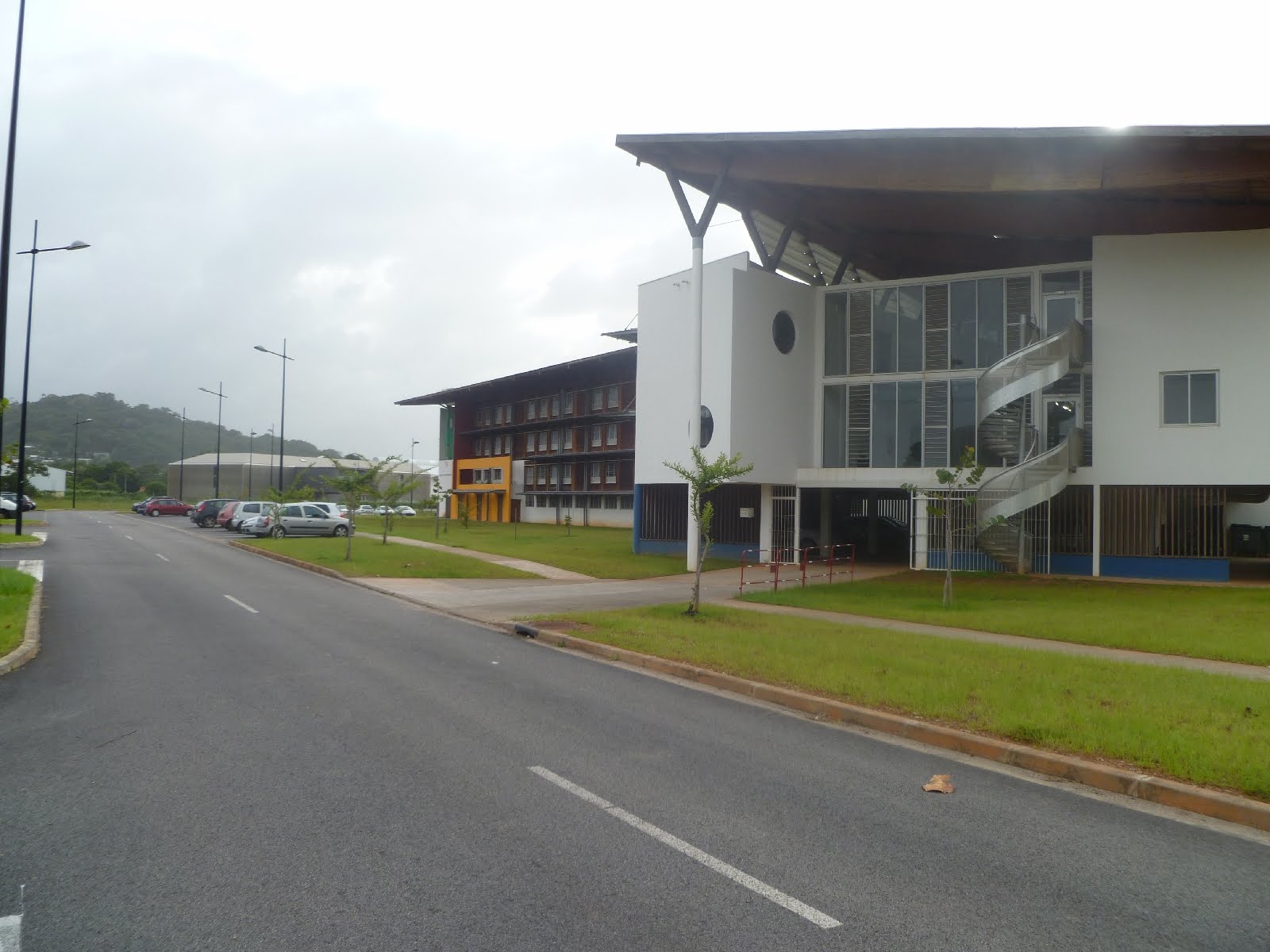
I had wanted to show you pictures of the brand-new university campus and compare them with the old, dingy campus that generations of students had to endure. However, my disk readers for my memory card have given out on me, so for the moment there will be no new photos until I resolve the situation. However, this is the new campus. Quite pretty, very modern. Post 100 tomorrow. 




Sunday, March 27, 2011
no posts
Sorry no posts last night and not really today. But for post 100 i've got something good in mind. just one post between this one and number 100.
Subscribe to:
Posts (Atom)